
Conductance — Why Geometry Matters
Estimated time: 25–30 minutes
Explain the concept of conductance; describe how tube length, diameter, and geometry affect gas flow; identify conductance bottlenecks in simple system layouts. Competency: M03-COMP-02, Indicators M03-IND-02.01, M03-IND-02.02, M03-IND-02.03
Orient
You now know that gas behaviour changes with pressure. At high pressure, gas flows like a fluid. At low pressure, molecules bounce off walls randomly.
But here's the practical question: how easily does gas flow through the connection between the chamber and the pump?
This property is called conductance — and it's one of the most important concepts in vacuum system design.
Core Content: What Is Conductance?
Think of conductance as the "ease of flow" through a tube or fitting. A wide, short tube has high conductance — gas flows through it easily. A long, narrow tube has low conductance — gas struggles to get through.
Analogy: Conductance is like the diameter of a drinking straw. You can drink easily through a wide straw (high conductance).
Through a cocktail stirrer straw (low conductance), you have to work much harder for the same flow. The beverage is the same — but the pathway makes all the difference.
Why it matters: A pump might have an impressive nominal pumping speed (say, 10 litres per second).
But if the connection between the pump and the chamber is a long, narrow tube, the effective pumping speed at the chamber could be a fraction of that — perhaps only 3 litres per second. The tube chokes the flow. The pump is powerful, but the connection wastes most of that power.
How Conductance Changes with Flow Regime
This is where Module 3 connects to Lesson 2:
In viscous flow (high pressure):
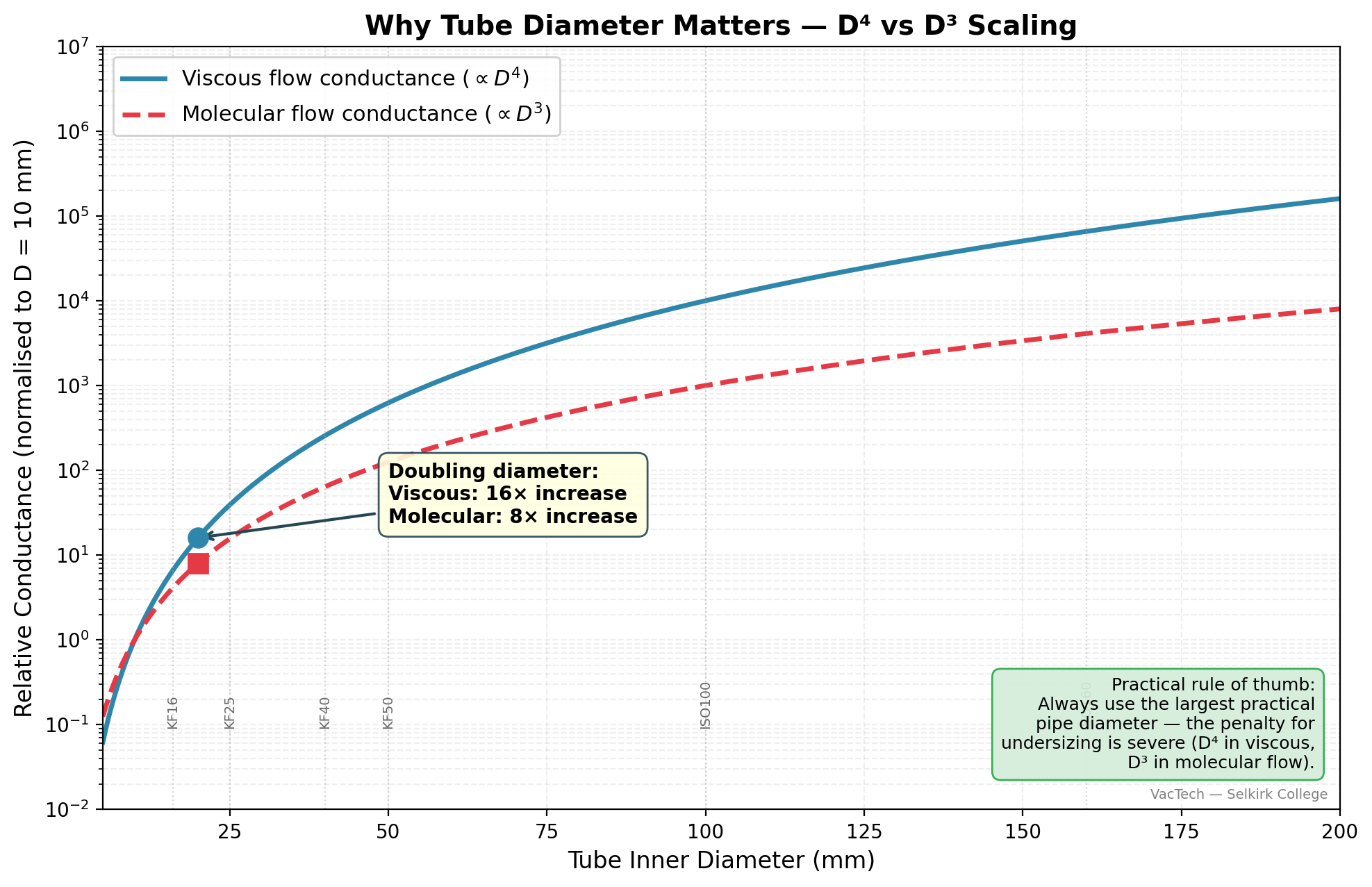
- Conductance depends strongly on tube diameter (to the fourth power for round tubes)
- Conductance also depends on the average pressure (higher pressure = higher conductance)
- A moderately narrow tube still works well because the gas is pushed through collectively
In molecular flow (low pressure):
- Conductance depends on tube diameter (to the third power) and length
- There is NO pressure dependence — conductance is fixed by geometry alone
- A narrow tube becomes a severe bottleneck because molecules bounce randomly off walls
The critical insight: A tube that performs adequately at 100 mbar (viscous flow) may become a crippling bottleneck at 0.01 mbar (molecular flow). The tube hasn't changed — but the physics of flow through it has.
The Three Geometry Factors
Three physical factors determine the conductance of any connection:
Factor 1: Diameter
Wider is dramatically better. In molecular flow, doubling the diameter of a tube increases its conductance by a factor of eight (diameter cubed). This is why vacuum engineers obsess over port sizes and connection diameters — a few millimetres make a large difference.
On R1-A: The foreline (R1-L-FL) connecting R1-V-ISO to R1-P-RP has a specific diameter. If this line were half the diameter, the effective pumping speed at the chamber would drop dramatically at low pressure — even though the pump itself is unchanged.
Factor 2: Length
Shorter is better. Conductance in molecular flow is inversely proportional to tube length. A tube twice as long has half the conductance — the gas must survive twice as many random wall bounces to get through.
On R1-A: This is why the pump is positioned close to the chamber. A 1-metre foreline has roughly half the conductance of a 0.5-metre foreline. In industrial installations where pumps must be placed far from chambers, this becomes a serious design consideration.
Factor 3: Bends and Restrictions
Every bend, elbow, valve, and fitting adds resistance. In molecular flow, a 90° elbow forces molecules to change direction by bouncing off additional surfaces — many molecules bounce back the way they came. Valves (like R1-V-ISO) introduce restrictions even when fully open, because the internal geometry is narrower than the connecting tube.
On R1-A: R1-V-ISO is an angle valve. Even fully open, its internal geometry creates some restriction. This is a design trade-off — the valve provides essential control (isolation), but it costs some conductance.
Effective Pumping Speed
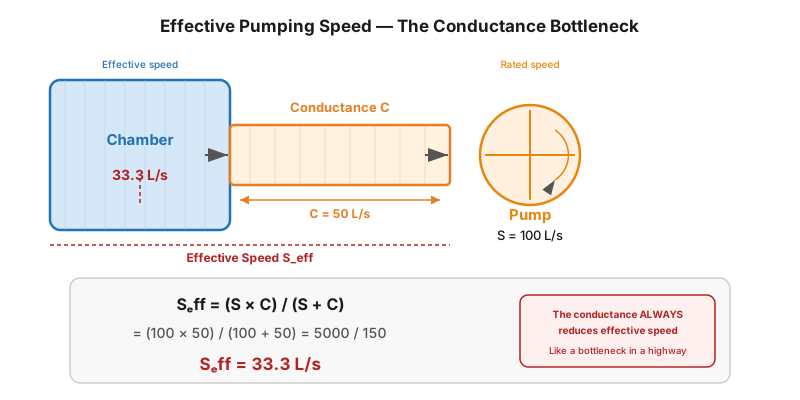
This is where everything comes together. The pump has a nominal speed (S_pump). The connection has a conductance (C). Effective pumping speed is the actual rate at which gas is removed at the chamber — the pump's rated speed is like a car's horsepower, but what matters is the real-world performance after accounting for the plumbing between pump and chamber.
Effective pumping speed at the chamber is always less than the pump's nominal speed. The narrower or longer the connection, the more pumping speed is lost before it reaches the chamber. Effective speed is always limited by whichever is smaller — the pump's capacity or the connection's ability to deliver gas.
This relationship can be expressed as an equation. You don't need to memorise or use this equation — the relationship described above is what matters.
Effective speed ≈ (S_pump × C) / (S_pump + C)
The relationship tells you something powerful:
- If C is much larger than S_pump: Effective speed ≈ S_pump. The connection is wide open and doesn't limit performance. The pump is the bottleneck.
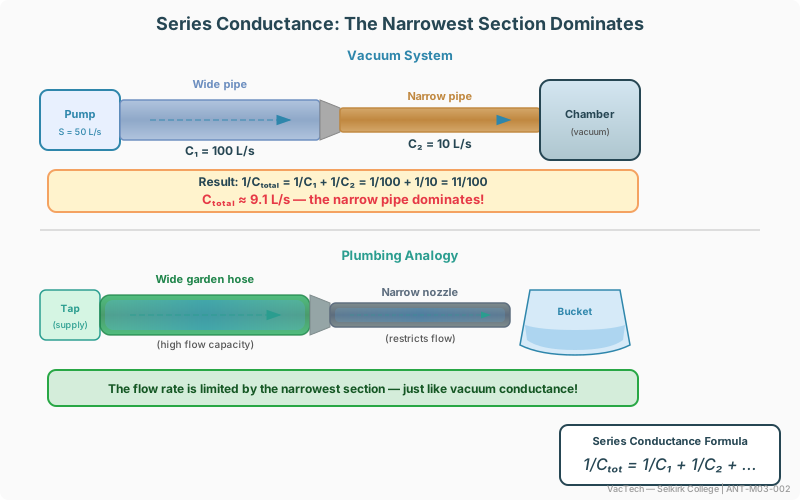
- If C is much smaller than S_pump: Effective speed ≈ C. The connection is the bottleneck. A bigger pump won't help — the tube can't deliver gas to it any faster.
- If C equals S_pump: Effective speed ≈ half of S_pump. You've lost half your pumping speed to the connection.
The practical rule: If the conductance of the connection is less than or comparable to the pump speed, the connection is your bottleneck. No amount of pump upgrade will fix a conductance problem.
You now understand what conductance is, how it changes with flow regime, and how the three geometry factors (diameter, length, bends) determine it. You can also explain why effective pumping speed is always less than nominal pump speed. Next, you'll see this bottleneck effect illustrated on R1-A.
Conductance Bottleneck — Visual Summary
The diagram below makes the bottleneck concept concrete. It shows the R1-A flow path from chamber to pump with the foreline highlighted, then compares two scenarios side by side — a wide foreline that preserves most of the pump's speed and a narrow foreline that wastes it. Pay attention to the annotated pumping-speed values at each end of the connection.
The key observation: the pump is identical in both panels — only the foreline diameter changed. In the narrow-foreline case, the connection wastes more than two-thirds of the pump's capacity. This is why vacuum engineers treat conductance as seriously as pump selection.
Identifying Bottlenecks: The R1-A Example
On R1-A, the gas path from chamber to pump during ROUGHING is:
R1-CH → R1-V-ISO → R1-L-FL → R1-P-RP
Each element has a conductance:
- R1-V-ISO (isolation valve): Creates a restriction even when fully open. This is the narrowest point in the flow path when it's open.
- R1-L-FL (foreline): A tube of fixed diameter and length. Its conductance drops significantly at molecular flow pressures.
- R1-P-RP (pump inlet): The pump's inlet port diameter determines the maximum gas flow the pump can accept.
At high pressure (viscous flow): All three elements have sufficient conductance. The pump is the limiting factor. Pump-down is fast.
At low pressure (molecular flow): The foreline and valve become the limiting factors. The pump may be capable of lower pressure, but the connection can't deliver gas fast enough. This is one reason (alongside gas load from M02) why pump-down slows at lower pressures.
Basic Vacuum Practice — Varian
Basic Vacuum Practice, Ch. 4, pp. 121–135: Pipe geometry effects on conductance — diameter and length relationships with worked examples.
This extract provides the quantitative detail behind the pipe geometry effects discussed above. Study the worked examples showing how diameter and length affect conductance — these relationships explain why the foreline length difference between Rig A and Rig B produces such different results at molecular flow pressures.
Scenario: Two identical R1-A rigs, same pump, same chamber. Rig A has a 0.3 m foreline. Rig B has a 1.0 m foreline (because the pump had to be placed further away).
At 100 mbar (viscous flow): Both rigs pump down at nearly the same rate. The foreline conductance is high in viscous flow, so the length difference doesn't matter much.
At 0.01 mbar (molecular flow): Rig B is significantly slower. The 1.0 m foreline has roughly one-third the conductance of the 0.3 m foreline (conductance is inversely proportional to length).
Rig B's effective pumping speed at the chamber is much lower. The pump is the same, but the connection wastes most of its capacity.
Takeaway: In molecular flow, the path from chamber to pump matters as much as the pump itself. Short, wide, straight connections preserve pumping speed. Long, narrow, bent connections waste it.
Misconception: If the system is pumping too slowly, install a bigger pump.
Reality: If the bottleneck is conductance (which it often is at low pressure), a bigger pump makes almost no difference. Imagine a massive pump connected to the chamber through a drinking straw — the straw limits the flow regardless of pump capacity. The correct response depends on where the bottleneck is: if it's the pump, upgrade the pump; if it's the connection, improve the conductance (wider tube, shorter path, fewer bends).
What You Can Now Do
By the end of this section, you can:
- Explain what conductance means in practical terms
- Describe how tube diameter, length, and bends affect conductance
- Explain why conductance matters more at low pressure (molecular flow) than at high pressure (viscous flow)
- Identify the conductance bottleneck in a simple system like R1-A
- Explain why effective pumping speed is always less than nominal pump speed
- Explain why a bigger pump doesn't always improve performance
Next Steps
You now understand how gas gets from the chamber to the pump — and what slows it down. The next lesson brings it together: interpreting pump-down curves using flow regime and conductance concepts.