
Seals — Where Vacuum Meets Atmosphere
Estimated time: 25–30 minutes
Identify common vacuum seals (elastomer O-rings, metal gaskets); explain how each type maintains vacuum integrity; describe failure modes. Competency: M04-COMP-01 (M04-IND-01.04), M04-COMP-02 (M04-IND-02.02)
Orient
Every vacuum system has joints — places where two components meet. Each joint is a potential leak path. The seal at each joint is the barrier between vacuum inside and atmosphere outside.
Seals are where most vacuum leaks occur. Understanding seal types, their capabilities, and their failure modes is directly relevant to the diagnostic skills you've been building since Module 2.
Core Content: Elastomer Seals (O-Rings)
What they are: Circular rings made from flexible polymer material (usually Viton, Buna-N/nitrile, or silicone). They sit in a groove at the joint between two components and compress to form a gas-tight seal.
How they work: When two flanges are bolted together, the O-ring is compressed into its groove. The compressed rubber pushes outward against both surfaces, creating a gas-tight barrier. The seal is maintained by the elastic force of the compressed material — as long as the O-ring stays compressed and undamaged, the seal holds.
Common elastomer materials:
| Material | Common Name | Max Temp | Typical Use | Notes |
|---|---|---|---|---|
| FKM | Viton | ~200°C | General-purpose, chemical resistance | The standard in vacuum. Used on R1-A. |
| NBR | Buna-N / Nitrile | ~100°C | Budget applications, rough vacuum | Cheaper but limited temperature range |
| VMQ | Silicone | ~200°C | Clean applications, low outgassing | Good for food/pharmaceutical vacuum |
| FFKM | Kalrez-type | ~300°C | High-temp, aggressive chemistry | Expensive — used where Viton fails |
On R1-A: The seals on R1-V-ISO, R1-V-VENT, and R1-CH are elastomer O-rings (typically Viton). These are adequate for rough vacuum but would limit the system if high-vacuum or ultra-high-vacuum performance were needed.
Advantages of elastomer seals:
- Reusable (many seal-break and reseal cycles)
- Forgiving of minor surface imperfections
- Inexpensive and widely available
- Easy to install — no special tools required
Limitations of elastomer seals:
- Permeation: gas molecules (especially helium and water vapour) can slowly diffuse through the rubber
- Outgassing: elastomers release gas under vacuum, contributing to gas load (M02 concept)
- Temperature limit: cannot withstand full UHV bake-out temperatures
- Degradation: UV light, ozone, and some chemicals degrade elastomers over time
- Compression set — when an O-ring has been squeezed for so long that it permanently loses its springiness, like an old rubber band that no longer snaps back: after prolonged compression, O-rings may permanently deform and lose sealing force
Core Content: Metal Seals (CF Gaskets)
What they are: Flat metal rings (usually oxygen-free copper, OFHC) that sit between two knife-edge flanges. When the flanges are bolted together, the knife edges bite into the soft copper, creating a metal-to-metal seal.
How they work: Unlike elastomers, metal gaskets do not rely on elastic recovery. They rely on plastic deformation — permanent bending or reshaping of metal, like bending a paperclip: the metal stays where you put it, unlike rubber that springs back.
The knife edge permanently deforms the copper. This creates an extremely tight seal with essentially zero permeation and negligible outgassing.
Where they're used: CF (ConFlat) flanges on high-vacuum and ultra-high-vacuum systems. Any system that needs to be baked above 200°C or requires base pressures below 10-7 mbar uses metal seals.
Advantages of metal seals:
- Zero permeation (metal is effectively impermeable to gas)
- Negligible outgassing (clean copper surface)
- Withstands bake-out to 450°C
- Achieves UHV-compatible seal quality
Limitations of metal seals:
- Single use — the copper gasket must be replaced each time the joint is opened
- Requires precise bolt torquing (uneven tightening = leak)
- More expensive per seal cycle
- Less forgiving of surface damage — a scratch on the knife edge can compromise the seal
You can now differentiate both seal types: elastomer O-rings (elastic, reusable, limited by permeation and outgassing) and metal CF gaskets (plastic deformation, single-use, UHV-capable). The failure modes table below connects this knowledge directly to diagnostic signatures.
O-Ring Failure Modes
Understanding how seals fail helps you interpret diagnostic data:
| Failure Mode | What Happens | Diagnostic Signature |
|---|---|---|
| Pinch or cut | O-ring damaged during installation (caught between surfaces, nicked by a tool) | Immediate leak after assembly — rate-of-rise test shows constant rate |
| Compression set | O-ring permanently deformed after long service — loses elasticity | Gradual leak development — system that once sealed well now shows slow deterioration |
| Chemical attack | Incompatible process gas degrades the elastomer | Accelerating leak rate; O-ring may appear swollen, cracked, or discoloured when inspected |
| Thermal degradation | O-ring exposed to temperatures beyond its rating | Hardening, cracking; seal becomes brittle and may fragment |
| Particle contamination | Debris on the O-ring or sealing surface prevents proper compression | Leak at one point (where the particle sits) — may be intermittent if the particle shifts |
Basic Vacuum Practice — Varian
Basic Vacuum Practice, Ch. 5, pp. 140–150: CF (ConFlat) flange assembly — knife-edge seal detail, gasket compression, and bolt torque sequence.
This extract shows the CF (ConFlat) flange assembly in detail — the knife-edge seal mechanism, gasket compression sequence, and bolt torque pattern. Study how the knife-edge bites into the copper gasket to create the metal-to-metal seal described above.
Visual Reference: Seal Types Comparison
The cross-section diagrams below show the two fundamental sealing mechanisms side by side. On the left, observe how the elastomer O-ring compresses within its groove to create an elastic seal; on the right, observe how the CF knife-edge permanently deforms the copper gasket to create a metal-to-metal seal.
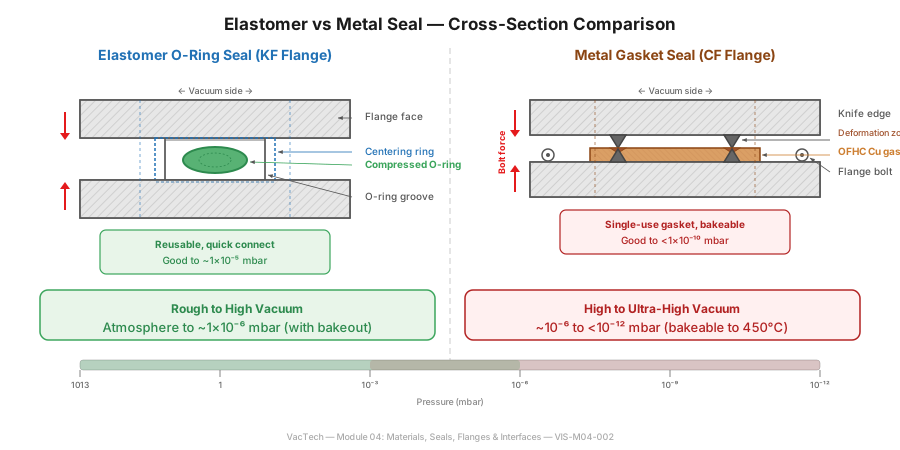
The key distinction is in the word elastic versus plastic. The O-ring springs back when uncompressed — it can be reused. The copper gasket is permanently deformed by the knife-edge — it must be replaced every time the joint is opened.
This single difference explains why CF connections achieve lower base pressures (zero permeation through solid metal) but require more time and cost per assembly cycle.
Misconception: When assembling a vacuum joint, tighten the bolts as much as possible for the best seal.
Reality: Over-tightening can damage seals. For O-rings, excessive compression causes extrusion — the rubber gets pushed out of its groove, like toothpaste squeezed out of the tube when the cap is tightened too far — causing damage and eventual failure.
For CF gaskets, over-tightening can deform the knife edge or warp the flange. The correct approach is controlled, even tightening to specification — not maximum force.
Basic Vacuum Practice — Varian
Basic Vacuum Practice, Ch. 5, pp. 136–145: Flange type comparison — clamp vs bolted configurations, KF vs ISO-K vs CF sealing mechanisms.
This extract compares flange types side by side — clamp vs bolted configurations and the sealing mechanisms of KF, ISO-K, and CF standards. Notice how the sealing principle changes from elastic compression (O-ring) to plastic deformation (knife-edge) as performance requirements increase.
What You Can Now Do
By the end of this section, you can:
- Identify elastomer O-rings and metal gaskets as the two main seal types in vacuum
- Describe how each seal type works (elastic compression vs plastic deformation)
- Explain why elastomer seals limit ultimate vacuum performance (permeation, outgassing)
- Recognise O-ring failure modes and their diagnostic signatures
- Explain why CF metal seals are required for UHV applications
- Explain the trade-off between reusability (O-rings) and ultimate performance (metal gaskets)