
The Residual Gas Analyser & Diagnostic Integration
Estimated time: 15–20 minutes
Describe the purpose and basic function of an RGA (awareness level); integrate gas load, contamination, and rate-of-rise concepts into a diagnostic framework. Competency: M02-COMP-02 (M02-IND-02.04), M02-COMP-01 (M02-IND-01.03)
Orient
So far in Module 2, you've learned to identify gas sources, interpret rate-of-rise data, and recognise contamination symptoms. But there's a gap: when the gauge tells you the pressure is too high, it doesn't tell you what kind of gas is causing the problem.
Knowing the total pressure is like knowing the total weight of a truck's cargo without knowing what's in the boxes.
Is it water vapour? Nitrogen from a leak?
Pump oil? Each answer leads to a different response.
This is where the Residual Gas Analyser (RGA) comes in.
Core Content: What Is an RGA?
An RGA is an analytical instrument that identifies the types and quantities of gas molecules present in a vacuum system. Instead of measuring total pressure (like R1-G-CH), an RGA breaks the gas down by molecular mass and tells you how much of each species is present.
What it does:
- Ionises gas molecules inside the vacuum chamber
- Separates the ions by mass-to-charge ratio
- Produces a mass spectrum — a graph showing the abundance of each gas species
What the spectrum tells you:
- Mass 18 (water): High water signal means surface desorption or water contamination — consider longer pumpdown, bake-out, or better drying practices
- Mass 28 (nitrogen/CO): If nitrogen is dominant and unexpectedly high, suspect an air leak (nitrogen makes up 78% of atmosphere)
- Masses 28 + 32 (nitrogen + oxygen in atmospheric ratio): Strong air leak signature — nitrogen and oxygen in roughly 4:1 ratio means atmosphere is getting in
- Masses 39–44+ (hydrocarbon fragments): Pump oil backstreaming or hydrocarbon contamination
- Mass 4 (helium): Used deliberately in leak detection — if you see helium and you're not doing a leak test, something unexpected is happening
What it doesn't do:
- An RGA does not fix problems — it identifies them
- An RGA requires vacuum below approximately 10-4 mbar to operate (it's a high-vacuum instrument)
- Interpreting RGA spectra requires training and experience
Why This Matters (Awareness Level)
R1-A does not have an RGA — it's a rough vacuum training rig, and RGAs operate in higher vacuum ranges. But understanding that RGAs exist — and what they can tell you — is important for three reasons:
- You may encounter RGA data in your work. If a colleague or engineer shares an RGA spectrum, you should understand what it's showing you and how it relates to the gas load concepts you've learned.
- It changes how you think about diagnosis. Knowing that gas species can be identified means you think beyond "pressure is high" to "what kind of gas is causing the high pressure?" This is a higher level of diagnostic reasoning.
- It connects to escalation. When your rate-of-rise test suggests a problem but you can't determine the cause from pressure data alone, requesting an RGA scan is a legitimate and specific escalation action: "I recommend an RGA scan to identify the dominant gas species at current base pressure."
You now understand what an RGA is, what its mass spectrum reveals, and why it matters for diagnosis — even though R1-A doesn't have one. The diagnostic framework below brings together everything from Module 2 into a single structured approach.
Diagnostic Integration: The Module 2 Framework
Let's bring everything together. When you encounter a vacuum system that isn't performing as expected, here is the diagnostic framework built from Module 2 concepts:
MODULE 2 DIAGNOSTIC FRAMEWORK

STEP 1: Compare actual pumpdown to expected pumpdown
├── Normal pumpdown curve? → System is likely clean, no action needed
└── Slow pumpdown or elevated base pressure? → Go to Step 2

STEP 2: Perform rate-of-rise test (ISOLATED state)
├── Decreasing rate → Outgassing (normal or contamination-related)
│   ├── Rate matches expectations → Normal outgassing, document and continue
│   └── Rate higher than expected → Possible contamination, go to Step 3
├── Constant rate → Real leak
│   ├── Rate > 1 mbar/min → Gross leak, escalate immediately
│   └── Rate < 1 mbar/min → Minor leak, escalate with data
└── Pattern unclear → Consider virtual leak, go to Step 3

STEP 3: Consider contamination
├── Was chamber recently opened? → Check handling procedures
├── Was venting done through R1-FLT-VENT? → Check filter condition
├── Does performance improve with pump-down cycling? → Water contamination
├── Does performance NOT improve? → Oil or persistent source
└── When in doubt → Escalate with documented evidence
    "Recommend RGA scan to identify dominant gas species"
Reading an RGA Spectrum
The paired spectra below show what an RGA reveals in two contrasting situations. Compare the relative peak heights between the clean-system spectrum and the air-leak spectrum — the pattern shift is the diagnostic signal.
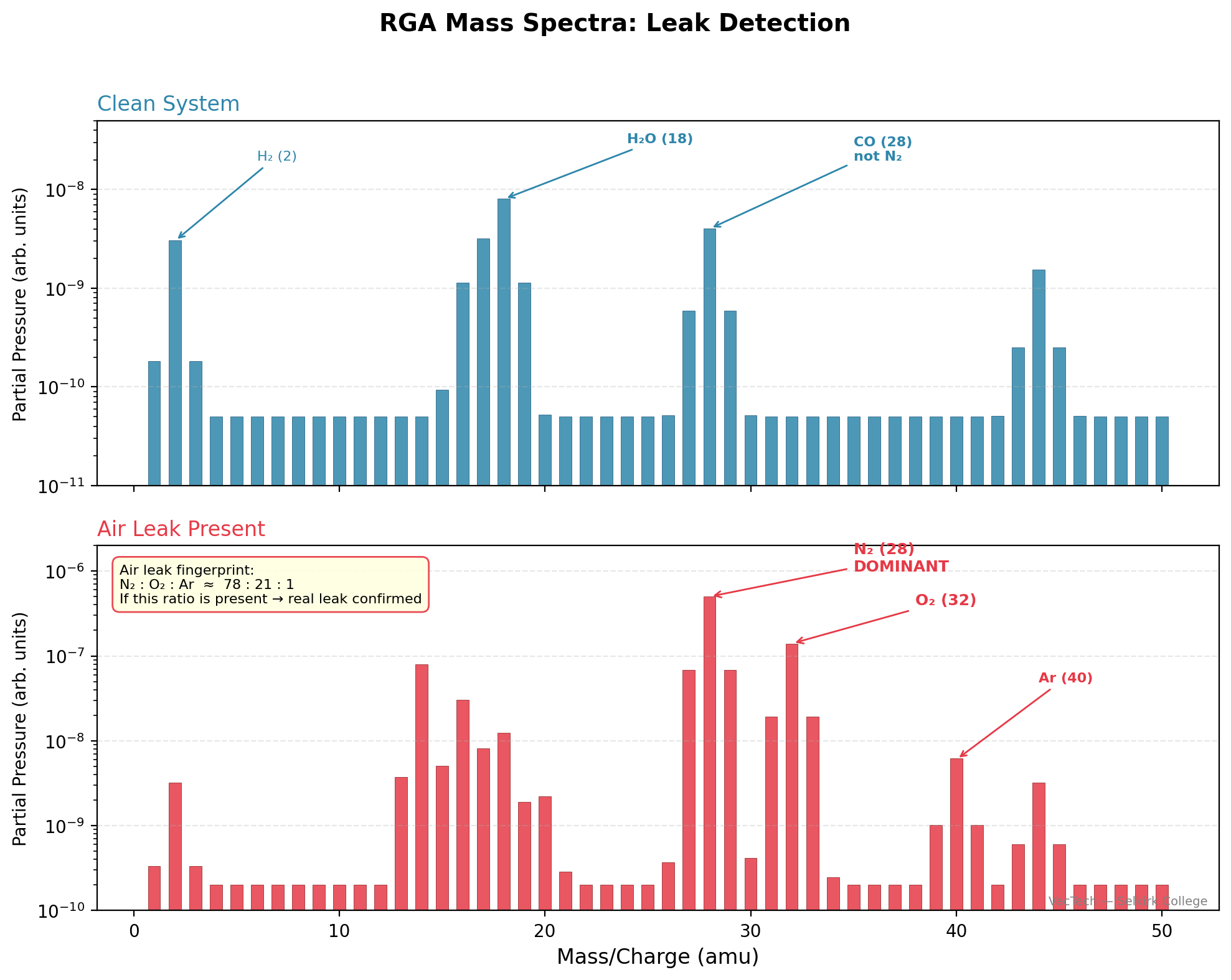
In the clean-system spectrum, water dominates because surface desorption is the primary residual gas source — exactly what you would expect from Lesson 2. In the air-leak spectrum, nitrogen and oxygen appear in the characteristic 4:1 atmospheric ratio, immediately confirming that the chamber has an unintended connection to the outside air. This is the kind of species-level insight that a total-pressure gauge alone cannot provide.
Ideal vs. Real Vacuum Behaviour
In an ideal vacuum system, you'd pump out all the gas and reach perfect vacuum. In reality, every system reaches an equilibrium where gas load from all sources equals the pump's effective speed.
The base pressure is determined by the balance between how much gas is entering the system and how fast the pump can remove it. More gas load means higher base pressure; more effective pumping speed means lower base pressure.
This relationship can be written as an equation. You don't need to calculate or memorise this — the balance concept above is what matters.
P_base = Q_total / S_eff
Where:
- P_base = the lowest pressure the system can achieve (base pressure)
- Q_total = total gas load from all five sources (throughput, measured in mbar·L/s)
- S_eff = effective pumping speed at the chamber (L/s)
The practical takeaway: you can improve base pressure by reducing gas load (cleaner system, better seals, bake-out) or increasing pumping speed (bigger pump, shorter foreline, larger conductance). Most practical improvement comes from reducing gas load — because that's where the problems usually are.
Misconception: If the system can't reach target pressure, you need a more powerful pump.
Reality: In most cases, a bigger pump won't solve the problem. If the gas load comes from contamination, leaks, or outgassing, a bigger pump just moves the equilibrium slightly — it doesn't eliminate the gas source.
The correct response is almost always to identify and reduce the gas load. Fix the leak. Clean the chamber.
Allow more pumpdown time for outgassing. A smaller pump in a clean system will outperform a large pump in a contaminated one.
What You Can Now Do
By the end of this section, you can:
- Describe what an RGA is and what information it provides (awareness level)
- Identify key mass spectrum peaks and their diagnostic meaning
- Apply the Module 2 diagnostic framework to a system that isn't performing as expected
- Explain the relationship between gas load, pumping speed, and base pressure (conceptual)
- Explain why reducing gas load is usually more effective than increasing pump size
- Formulate a specific escalation request for RGA analysis when appropriate