
Pressure Concepts & Units
Estimated time: 15–20 minutes
Distinguish absolute from gauge pressure; classify vacuum ranges; explain why range classification matters for system design and operation.
Orient
You know vacuum means "below atmospheric pressure." But below by how much? And measured from where? This section gives you the measurement framework that technicians and engineers use every day.
Core Content: Absolute vs. Gauge Pressure
Two reference points matter when you read a pressure gauge: absolute pressure and gauge pressure.
Absolute Pressure
Absolute pressure is measured from perfect vacuum — true zero.
A reading of 500 mbar absolute means there are 500 mbar worth of gas molecules pushing on everything. This is what vacuum technicians use because it tells the truth about what's happening inside the system. It's independent of location, weather, or altitude.
Absolute is what you use in vacuum work. When we talk about pressure in this course without qualification, we mean absolute.
Gauge Pressure
Gauge pressure is measured from local atmospheric pressure.
A reading of –100 mbar gauge means 100 mbar below atmosphere. The minus sign is important — it shows direction (below zero). That works out to about 913 mbar absolute if you're at sea level on a normal day.
Gauge pressure is common in compressed air systems and hydraulics, but it's misleading in vacuum work because "atmospheric" varies with altitude and weather.
In Denver, atmospheric pressure is about 840 mbar instead of 1013 mbar. A reading of "–100 mbar gauge" means different absolute pressures at different altitudes. In vacuum work, that kind of ambiguity is dangerous.
In this course: when we say "pressure," we mean absolute unless stated otherwise.
Basic Vacuum Practice — Varian
Ch. 1, pp. 1–15: Atmospheric composition — gas species percentages, partial pressures, and the composition of residual gas at different vacuum levels.
This extract covers the foundational concepts you've just been introduced to — what the atmosphere is actually made of, and how we describe pressure at different scales. As you read, pay attention to the breakdown of gas species and their partial pressures. Notice how the composition of residual gas changes as pressure decreases — this becomes important when we discuss contamination and outgassing later in the course.
Pressure Ranges Have Names
Gas behaves very differently at different pressure scales. Industry has names for these ranges because the names encode physics:
| Range | Pressure Span | What Happens | Pumps Used |
|---|---|---|---|
| Rough Vacuum | 1000 down to ~1 mbar | Gas flows like a fluid; molecules collide constantly | Rotary vane, screw, scroll |
| Medium Vacuum | 1 down to 10-3 mbar | Transition between flow regimes; molecules beginning to behave individually | Rotary vane (low end), roots blower combo |
| High Vacuum | 10-3 down to 10-7 mbar | Molecular flow; gas molecules barely interact with each other | Turbomolecular, diffusion |
| Ultra-High Vacuum | Below 10-7 mbar | Extremely low density; surface science governs behaviour | Turbo + ion pump, cryopump, or diffusion pump + cryo |
The logarithmic pressure scale below puts these ranges in perspective — notice how each named range spans several orders of magnitude, and how the physics changes fundamentally as you move from left to right.
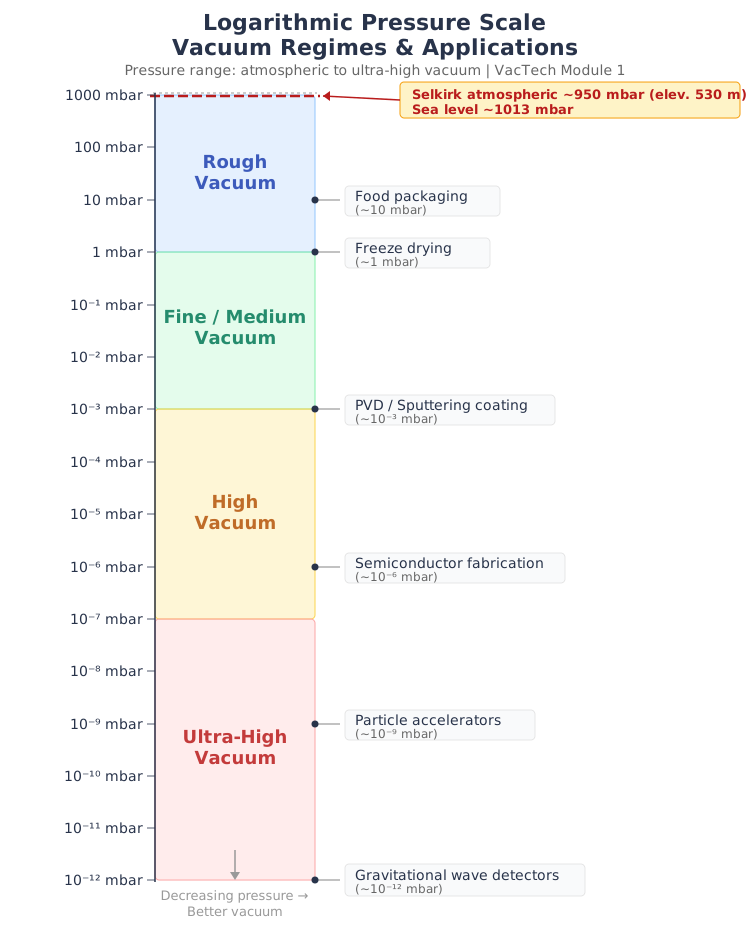
The key takeaway from this scale: R1-A operates in the first two decades (rough vacuum). The entire range below that — medium, high, ultra-high — is territory you'll explore conceptually in later modules.
For Module 1, we focus on rough and medium vacuum. R1-A operates in rough vacuum. You'll see pressures from ~950 mbar (local atmospheric at Selkirk) down to maybe 0.1 mbar on the rig.
Use the reference card below to convert between pressure units. For the best experience, click Expand Full Screen to view full screen.
Why These Ranges Matter
A pressure of 100 mbar and a pressure of 0.001 mbar are both "vacuum," but the physics is completely different.
- At 100 mbar, gas flows like a fluid. Pump performance is high, predictable, and fast.
- At 0.001 mbar, individual molecules bounce off walls randomly. The same pump delivers a fraction of its rated speed. Pumpdown becomes slow and dominated by molecular motion.
Knowing which range you're in tells you:
- What tools and instruments to use
- What pumps are appropriate
- What speed of evacuation to expect
- When to troubleshoot (is this a real problem or just molecular flow physics?)
- How system design choices are influenced by pressure range
On the shop floor, this means you know which gauge reading is normal and which signals a problem. A pressure drop from 1000 to 100 mbar in 30 seconds is expected.
A pressure drop from 0.01 to 0.001 mbar in 30 seconds might indicate a problem — or might just be the system entering molecular flow. Knowing the range tells you which interpretation is right.
You can now distinguish absolute from gauge pressure and explain why absolute matters. You know the four vacuum range names and what physics each range implies. The remaining sections connect these ranges to R1-A's gauge readings and common misunderstandings.
Rig Connection
R1-G-CH reads in mbar absolute.
- When you start, the reading is ~950 mbar (atmospheric at Selkirk, 530m elevation)
- As you evacuate, it drops into rough vacuum (roughly 1000 down to 1 mbar)
- When it reaches ~1 mbar, you're at the boundary where gas behaviour starts to change fundamentally
- If you could keep pumping (R1-A can't, but larger systems do), you'd enter medium vacuum below 1 mbar
Watch the rate of pressure drop. Fast drop in rough vacuum is normal. Slow drop below 1 mbar is expected — you're entering a different flow regime, not a system failure.
Misconception: The goal is always to reach the lowest possible pressure. If you can pump to 0.001 mbar, you should.
Reality: The target pressure depends on the process.
- A coating process might need only 10 mbar to work properly
- A leak test might need 0.1 mbar to detect defects
- A semiconductor process might need 10-5 mbar for chemistry to work
Running a system to 0.001 mbar when the process only needs 10 mbar wastes:
- Energy (the pump runs longer)
- Time (slow pumpdown in molecular flow)
- Pump life (more wear on a machine designed for different duties)
Knowing the right pressure for the job is more valuable than chasing the lowest number. Match the tool to the task, not the other way around — this principle applies whether you're operating a system, specifying one, or designing around one.
What You Can Now Do
By the end of this section, you can:
- Distinguish absolute from gauge pressure and explain why absolute matters in vacuum work
- Convert between common pressure units (mbar, Torr, Pa)
- Classify any pressure reading into the correct vacuum range
- Explain why the range matters for system design, component selection, and troubleshooting
- Predict (roughly) what gauge readings to expect when evacuating on R1-A
Next Steps
Next up is gas behaviour — what the molecules are actually doing at these different pressures, and why that changes everything about how the system works. But if you need a break, take one. This is solid ground to stand on.