
Welcome & Orientation
Estimated time: 10 minutes
Describe the scope, purpose, and structure of Module 1; identify the R1-A training rig components and explain how the rig grounds all learning.
What You'll Learn
Welcome to Vacuum Technology Fundamentals. This module builds the conceptual foundation that everything else rests on. By the end, you'll be able to:
- Describe what vacuum actually means (it's not what most people think)
- Read pressure values in three different unit systems
- Interpret a basic vacuum system schematic
- Identify what state a system is in just by looking at gauge readings and valve positions
These aren't abstract skills. Each one translates directly to shop-floor precision and design-stage clarity. This is the foundation.
Why This Matters
Whether you come from a trades background or a design role, understanding vacuum fundamentals changes how you see industrial systems.
Here is something fundamental about vacuum technology that shapes everything in this course: you cannot see what is happening inside a vacuum system. Gas molecules, leaks, contamination, outgassing, pressure changes — none of these are visible to the human eye.
This is not a limitation to worry about; it is simply the nature of the domain. Every procedure, checklist, and measurement technique you will learn exists to give you reliable information about things your senses cannot detect directly. Once you understand that, the "why" behind every protocol becomes clear.
On the shop floor, this knowledge means you can report what you see with precision — the right terms, the right observations, the right escalation. When a technician says "The foreline pressure is rising while the chamber is isolated," they're communicating something specific and actionable. That precision starts here.
At the design stage, it means you can contribute meaningfully to engineering conversations — grounded in physical reality rather than assumptions. You'll understand why a pump selection matters, what pressure range a process genuinely requires, and where the common failure modes live.
For designers and technologists: you won't be guessing when an engineer asks for your input, and you'll be better positioned to flag concerns before they become costly problems. The engineering decisions remain with qualified engineers — what this course gives you is the fluency to work effectively alongside them.
For engineers transitioning into vacuum systems: this course provides the conceptual foundation and domain-specific knowledge your engineering skills need to work effectively in this field. Vacuum behaviour isn't always intuitive — the physics of low-pressure gas is genuinely different from everyday experience, and getting that foundation right is what separates confident vacuum system design from expensive iteration.
And here's something worth knowing: This is the kind of understanding that AI can't replace.
An AI can look up pressure conversions, but it can't stand in front of a system, read the gauges, notice something unexpected, and know what questions to ask. You can. That's what this course builds.
The R1-A Training Rig
To make these concepts concrete, we use the R1-A training rig — a simplified vacuum system with a chamber, a roughing pump, two valves, a pressure gauge, and a barometric reference. It also has two inline protective filters that you'll learn about in later modules. Every concept in this module gets grounded in R1-A.
The image below shows the R1-A rig layout — take a moment to orient yourself to the physical system before we start labelling its parts.

You don't need to memorise this image — you'll build up component-by-component understanding through the lessons. For now, just notice that it's a compact, real system with identifiable parts.
- When we talk about pressure, you'll see it on R1-A's gauges
- When we talk about flow, you'll trace it through R1-A's lines
- When we talk about system states, you'll recognize them in R1-A's valve configurations
- When we talk about diagnostics, you'll practice the skills on R1-A
The rig is your anchor. It's not fancy, but that's the point — it's simple enough to understand completely while being realistic enough that the principles transfer to real systems.
How to Read Rig Labels
You'll see labels like R1-V-ISO throughout this course. Here's how to decode them — it's a simple system once you see the pattern:
R1 = Rig 1 (the first training rig). Later modules introduce R2 and R3. The letter after the hyphen tells you what type of component it is:
- V = Valve (R1-V-ISO, R1-V-VENT)
- P = Pump (R1-P-RP = Rig 1, Pump, Roughing Pump)
- G = Gauge (R1-G-CH = Rig 1, Gauge, Chamber side)
- L = Line (R1-L-FL = Rig 1, Line, Foreline)
- CH = Chamber (the sealed volume being evacuated)
- FLT = Filter (R1-FLT-VENT = Rig 1, Filter, Vent line)
The last part is the specific name: ISO = isolation, VENT = vent, CH = chamber, FL = foreline, EXH = exhaust, BX = barometric reference.
So R1-V-ISO reads as: "Rig 1, Valve, Isolation." R1-FLT-EXH reads as: "Rig 1, Filter, Exhaust." Once you see the pattern, every label is self-explanatory.
How This Module Works
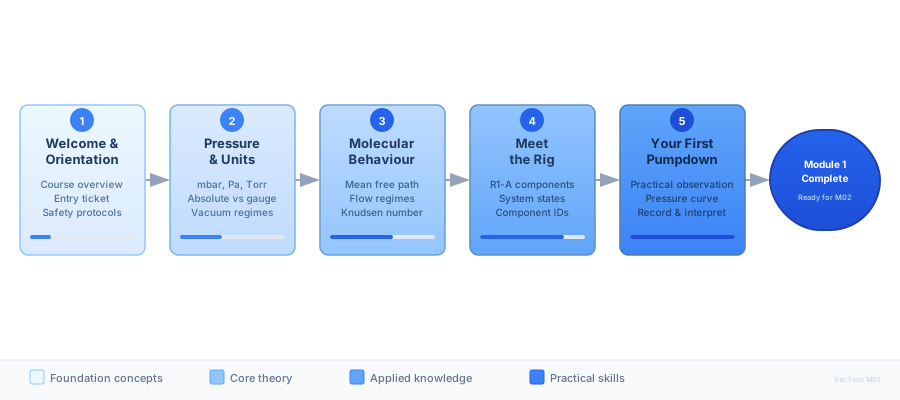
You'll work through 5 self-contained learning sections, each about 15–20 minutes of reading and activities:
- What Is Vacuum? — The definition that trips people up, why it matters, and what the rig shows you
- Pressure Concepts & Units — How to measure, which units matter, and what the ranges mean
- Gas Behaviour in Vacuum Systems — What molecules are actually doing and why the pressure drops the way it does
- Reading a Vacuum System Schematic — The visual language of vacuum systems and how to trace flow
- System States & Diagnostic Thinking — Bringing it all together: what the gauges and valve positions tell you
Each section covers a concept, connects it to the rig, surfaces common misconceptions, and ends with a clear payoff — something you can now do or understand that you couldn't before.
There are natural stopping points so you can break after any section and pick up where you left off. If you've had a long day, step away and come back fresh. This isn't a sprint.
Study Time
- Asynchronous: 3–4 hours (reading + activities at your own pace)
- Synchronous Session: 2 hours (live walkthrough, Q&A, scenario practice with the training rig or simulator)
Week 1 Reading
All reading for this module is listed here so you can plan your week. You'll use these same sources throughout the course — each module revisits them at greater depth, so the format stays familiar.
Each lesson in this module links directly to the specific pages you need for that topic — extracted from the source textbook so you can focus on what's relevant. These targeted extracts are the most convenient way to access the reading as you work through each lesson.
The complete reading for the module is also provided below if you prefer to read it in one sitting or want to see how the individual sections connect.
Basic Vacuum Practice — Varian
Ch. 1, pp. 1–35: Pressure definitions, units, vacuum ranges, gas behaviour, and system overview.
This is your primary reference throughout the course. Individual lessons link to the specific pages for each topic — use the complete extract below for reference or if you prefer to read ahead.
Introduction to Vacuum Technology — Milne Open Textbook
Chapter 1 (Vacuum as enabling technology) + Chapter 3 (Introduction to systems).
Accessible overview that complements the BVP reading.
Introduction to Vacuum Science & System Design — KJLC/ORNL (J.R. Gaines)
Sessions 1–3: Pressure fundamentals, units, gas laws, flow regimes.
Visual reference with real-world photos and practical anecdotes.
Vacuum Technology Book II, Part 2 — Pfeiffer Vacuum
Sections 1.1–1.2, pp. 9–16: Gas equation, mean free path, flow, conductance.
Introduction to Vacuum Technology — Pfeiffer Vacuum YouTube playlist
Videos: Parts 01, 02, 05 — visual introduction to vacuum system components.
Complete the reading alongside the lessons in any order. By the end of the week, aim to have covered the required sources above.